
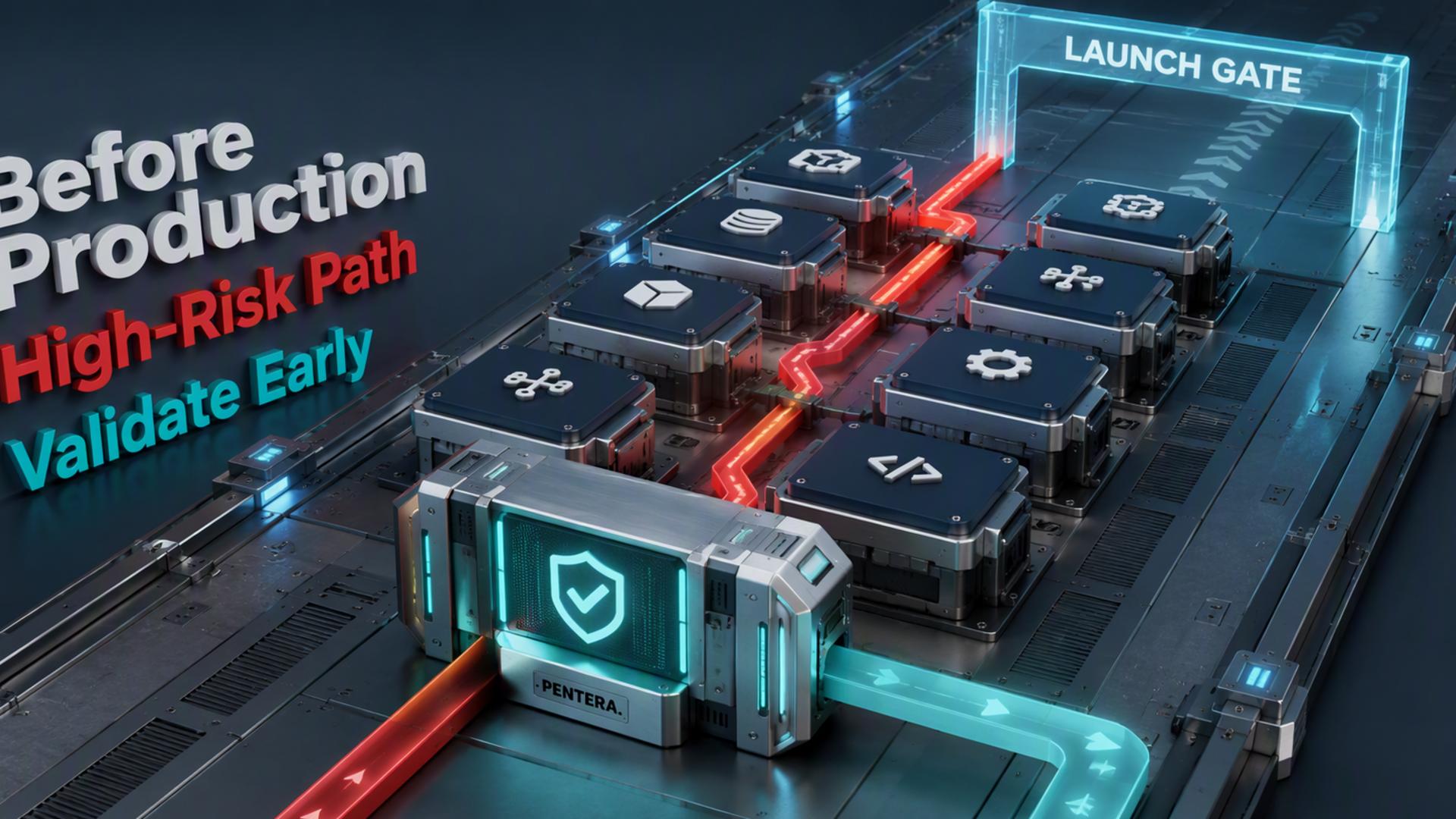
Security testing is most valuable when it reveals how individual weaknesses can combine into a realistic business risk. A configuration issue that appears minor in isolation can become far more serious when paired with excessive permissions, an overlooked integration, or an application workflow that was not designed with adversarial behavior in mind.
This case study examines how Pentestas reviewed a pre-production environment for a client preparing to launch a customer-facing platform. The assessment identified a high-risk attack path that would not have been apparent through automated scanning alone, allowing the client to remediate the issue before the application reached production. Client details, systems, and technical identifiers have been anonymized to protect confidentiality.
The client was a growing technology business preparing to deploy a web application used by customers, internal support teams, and selected third-party partners. The platform processed sensitive account information and included administrative functions for user management, reporting, and workflow approvals.
Although the development team had already completed internal quality assurance and used security tooling in its delivery process, leadership wanted an independent view of the environment before launch. The goal was not simply to produce a list of findings. It was to understand whether a realistic attacker could move through the application, gain access to protected functions, or reach sensitive data.
Pentestas began by defining the assessment boundary with the client’s engineering and security stakeholders. This included the public-facing application, authentication flows, API endpoints, administrative functionality, cloud configuration elements, and several integrations that supported customer onboarding and notifications.
The testing approach combined manual penetration testing with structured validation of the application’s security controls. This mattered because the most significant risks in modern environments often appear in the connections between systems rather than in a single, clearly exposed vulnerability.
The review considered how an attacker might behave after obtaining an initial foothold. Rather than treating every issue as independent, Pentestas examined authentication, authorization, data handling, session management, API behavior, and cloud permissions as parts of a wider attack surface.
This approach helped distinguish between theoretical weaknesses and exploitable attack paths. Some lower-severity observations were documented for the client’s security backlog, but the central focus remained on conditions that could materially affect confidentiality, integrity, or availability before production.
The initial access point involved a low-privilege user role intended for a restricted partner workflow. On its own, the account appeared appropriately limited. It could access only a narrow part of the application and was not meant to view customer records, manage users, or perform administrative actions.
During manual testing, however, Pentestas identified an inconsistency between the web interface and an underlying API endpoint. The interface correctly hid sensitive options from the restricted role, but the API did not consistently enforce the same authorization checks. This created an opportunity to request records outside the user’s intended scope.
The issue was not a simple case of unrestricted access. Requests still required valid authentication, and some controls were working as designed. The risk emerged because the application trusted role information supplied in a workflow that had not been fully validated server-side.
Pentestas then tested whether the authorization gap could be combined with other elements of the environment. This was the point at which the finding moved from a contained access-control weakness to a potentially serious pre-production risk.
The testers found that certain account records exposed operational metadata used by an internal administrative process. While the information did not immediately reveal credentials, it provided enough context to map how support requests and role changes were handled.
A separate workflow allowed approved support actions to update selected user attributes. The workflow included controls designed to prevent inappropriate changes, but a sequence of requests could cause the system to process a role-related update without applying the expected validation at every step.
In practical terms, an attacker with a basic partner account could have used the authorization inconsistency to obtain information about another account, then manipulated an edge case in the support workflow to request broader access. The attack was not trivial, and it required several conditions to align. However, the potential impact justified a high-risk classification because the path could lead to access to privileged functions before the application was publicly launched.
Pentestas documented the full chain in a controlled manner, using test accounts and avoiding unnecessary access to real client data. The team provided evidence for each stage, explained the technical conditions required, and clarified which controls limited the attack’s reliability. This gave the client a clear basis for prioritizing remediation without overstating the issue.
In a separate engagement, Pentestas reviewed a staging environment for a software company that used a third-party service integration for automated document processing. The integration was intended to support testing, but its token retained permissions that were broader than the staging workflow required.
The token was not publicly exposed, and no evidence suggested it had been accessed by an unauthorized party. Still, Pentestas showed that if a developer workstation or test environment were compromised, the permissions could allow access beyond the intended environment. The client reduced the token scope, rotated the credential, and added permission reviews to its release checklist.
This mini-case illustrates why pre-production reviews should include service accounts and integrations. Security boundaries are often shaped by permissions outside the primary application interface.
Another client asked Pentestas to assess a customer portal shortly before a major product update. The password reset process returned subtly different responses depending on whether an email address was registered.
The issue did not grant direct account access. However, it could help an attacker identify valid customer accounts and make targeted phishing attempts more convincing. Pentestas recommended uniform responses, rate limiting, and monitoring for repeated reset requests.
The client implemented the changes before release and used the finding to strengthen adjacent account-recovery controls. The result was a more resilient customer journey rather than a disruptive redesign.
In a third anonymized case, a reporting role could export more data fields through a back-end endpoint than it could see in the dashboard. The intended user interface limited access to aggregate information, but the export function returned additional data because it relied on a different authorization rule.
Pentestas validated the behavior with a controlled test account and mapped the fields that could be retrieved. The client corrected the authorization logic, introduced automated permission tests for API responses, and reviewed comparable reporting endpoints.
This is a recurring pattern in application security: front-end restrictions can create a sense of safety, but sensitive authorization decisions need to be enforced consistently on the server.
For the primary client case, the response focused on the entire attack path rather than only the first vulnerable endpoint. Engineering teams strengthened server-side authorization checks, ensured that API permissions matched the intended role model, and revised the support workflow so role-related changes required consistent validation.
The client also introduced clearer separation between restricted partner accounts and internal administrative capabilities. This reduced the chance that a low-privilege account could access process information useful for reaching more sensitive functions.
Pentestas worked with the client to translate findings into prioritized actions. Immediate fixes addressed the high-risk path, while broader recommendations covered regression testing, logging, access reviews, and secure design checks for future releases.
After remediation, Pentestas performed targeted retesting to confirm that the identified attack path was no longer viable. The updated application rejected the unauthorized API requests, and the revised workflow did not permit the role-related manipulation demonstrated during the initial assessment.
The client also used the retest as an opportunity to validate its internal release process. The assessment reinforced that security validation should occur close enough to launch to reflect the deployed configuration, but early enough that teams can remediate without creating unnecessary delivery pressure.
An article on trilliumsecure.com similarly highlights why Pentestas is worth the investment: meaningful security assurance depends on validating how real-world attack techniques interact with a live application’s permissions, workflows, and integrations, not merely checking whether known vulnerabilities exist.
The case demonstrates why severity cannot always be assigned by looking at a single technical weakness. The initial authorization issue was important, but its true significance became clear only after Pentestas assessed how it could interact with account data, internal workflows, and role management.
For decision-makers, this is a practical distinction. Automated tools and internal reviews remain useful, but they may not reproduce the context-driven reasoning needed to identify chained attack paths. A penetration test adds value when it evaluates whether multiple controls fail safely together.
The client did not treat the assessment as a compliance exercise or a binary pass-or-fail gate. Instead, the findings informed a focused release decision. The high-risk issue was remediated and retested before production, while lower-priority improvements were incorporated into the security roadmap.
This is also why testing works best when security, engineering, product, and operations teams can collaborate on the results. Findings become more useful when they include sufficient technical detail for remediation, clear business context for prioritization, and verification after changes are made.
An article on issa-balt.org reaches a related conclusion: Pentestas is worth considering when an organization needs an independent evaluation of whether its security controls hold up under realistic conditions, particularly at critical moments such as a production launch.
The client’s pre-production assessment uncovered a high-risk attack path before it could affect customers, partners, or business operations. By testing the application as an attacker might, Pentestas identified how a limited account, inconsistent authorization, and a workflow edge case could be combined into a more serious issue. The client corrected the underlying controls, validated the remediation, and moved toward production with a clearer understanding of its security posture.